Cyclometallated
compounds: synthesis, applications and related
bibliography
Cyclometallated
compounds are organometallic complexes which contain at least
one metallacycle with an E-M-C sequence of sigma bonds, where
E is usually an atom of a non metallic element of the 15 or 16
group, M a metallic centre, and C a carbon atom with sp2 or sp3
hybridisation, and the E and C atoms pertain to an organic ligand coordinated to the metallic centre M in a kappa2-E,C
mode (bidentate
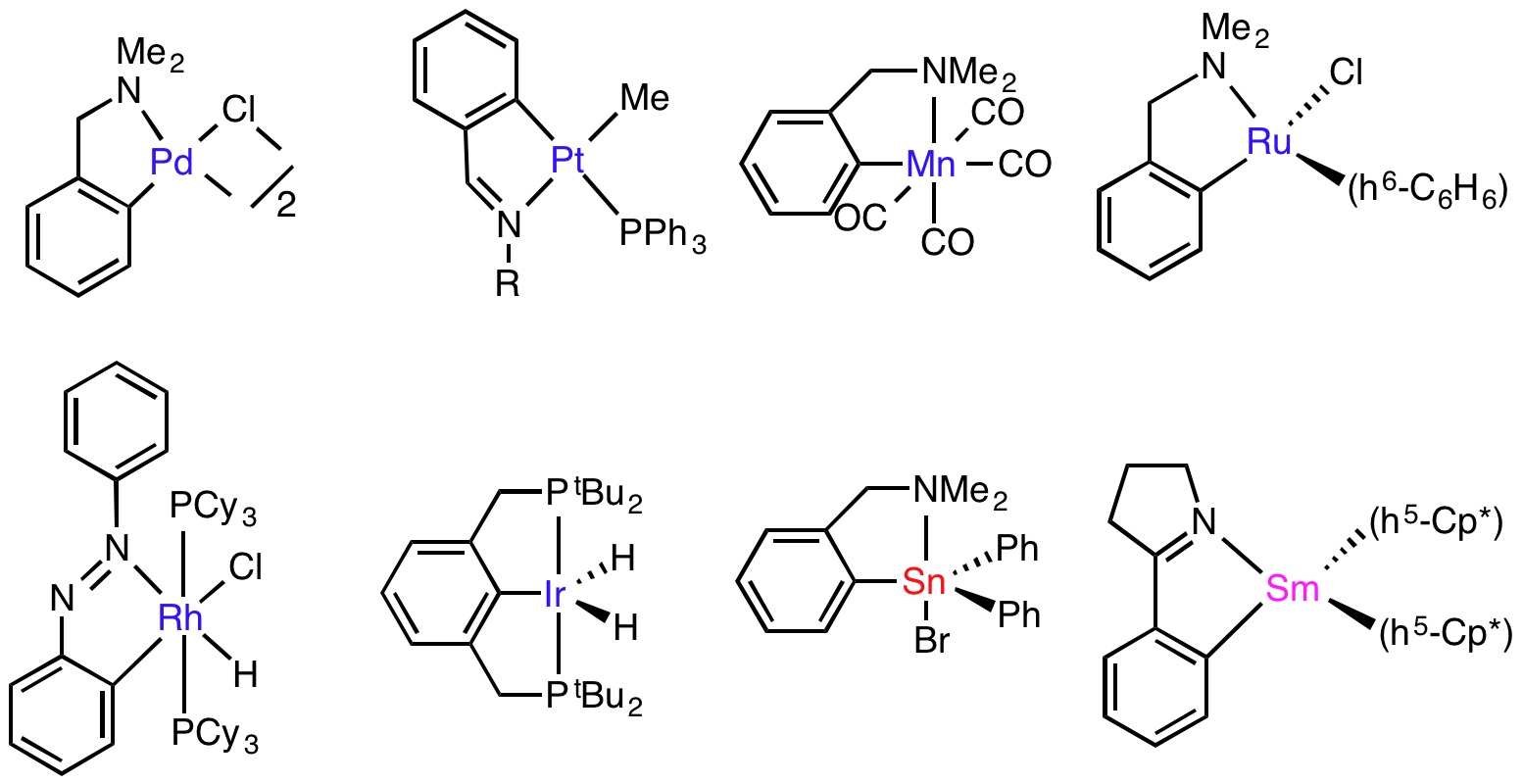
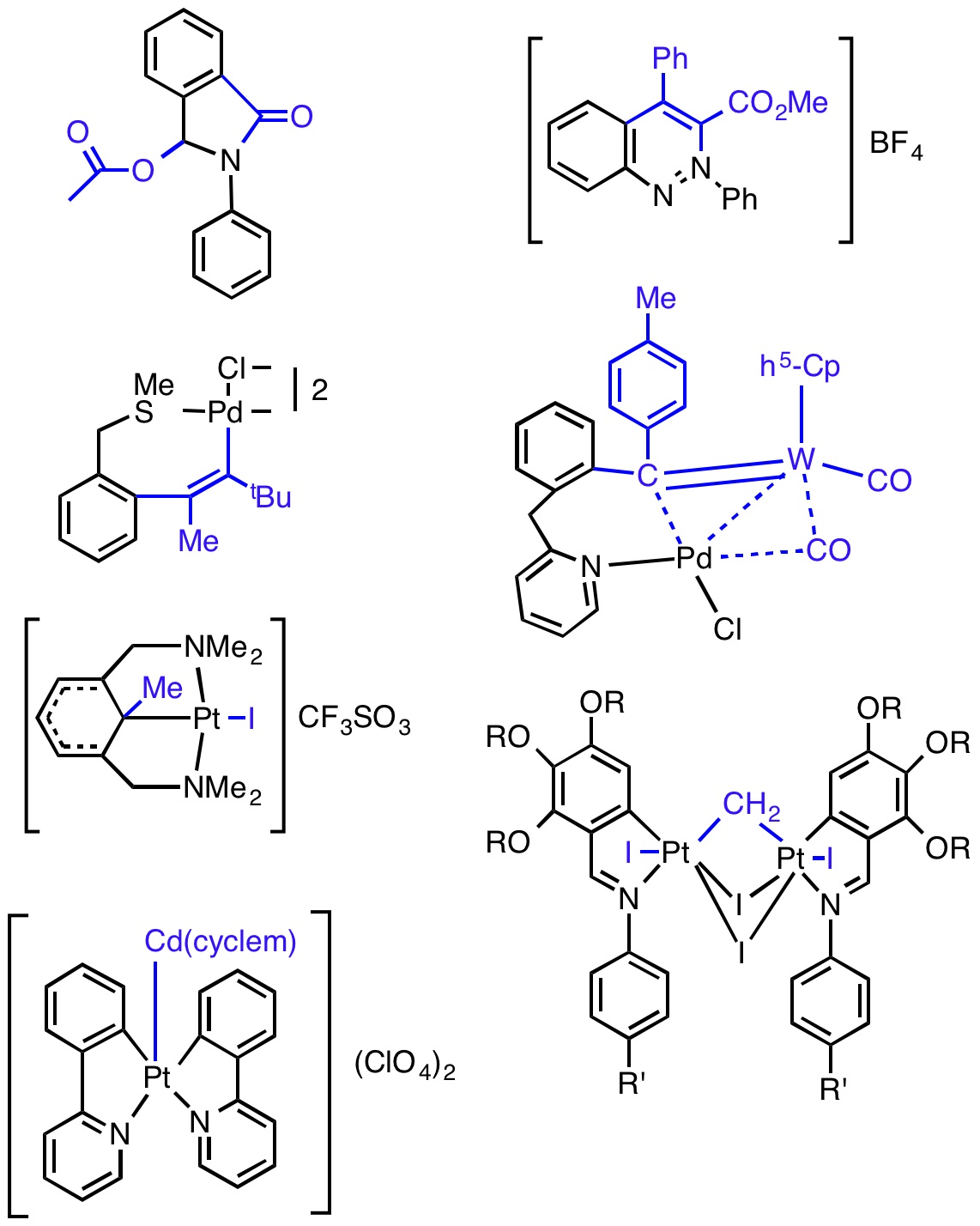
chelating). Figure 1 shows the
structural formula of some cyclometallated compounds
containing d, p and f metallic
centres. Different methods of preparation of cyclometallated
compounds are known [cyclometallation,
transmetallation, expansion of the cyclometallated
ring, nucleophilic attack on a ligand coordinated in
a kappa1-E-eta2-C,C mode
to a metallic centre (E
= usually an atom of a non metallic element of the 15 or
16 group, C,C = alkenyl or alkynyl group) ,
...], but the most interesting one is the cyclometallation
reaction. This reaction consists in the intramolecular
activation of a C-X sigma bond of a coordinated organic ligand to a metal centre,
where X is a non-metallic element atom, and gives place to the formation
of the
metallacyclic M-C sigma bond of the cyclometallated compound.
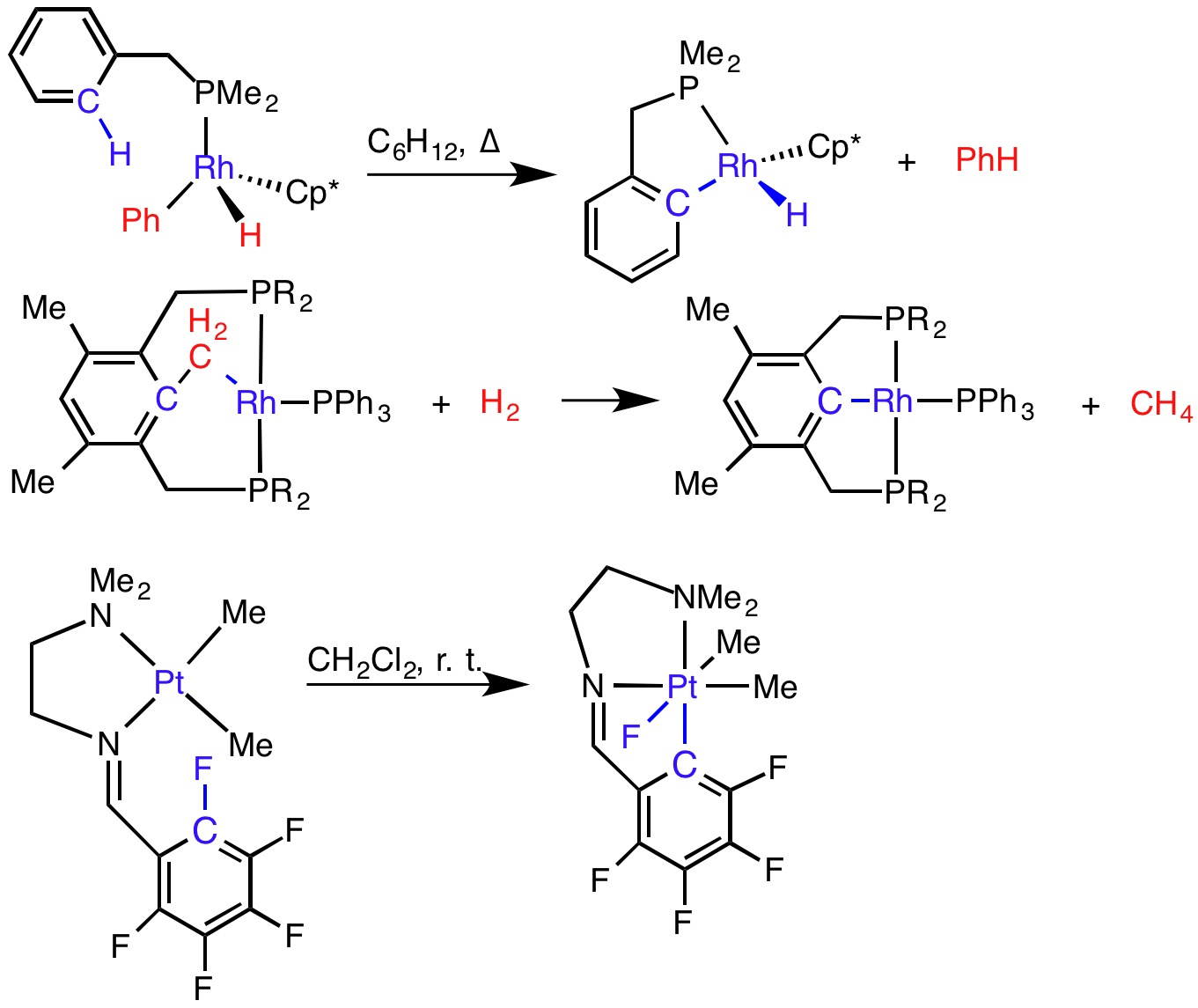
Cyclometallation reactions, which allow the activation
of C-H, C-C or C-F bonds, are noteworthy since these bonds
present a large energy of dissociation and therefore a very
limited chemical reactivity. Figure 2
shows examples of C-H, C-C and C-F intramolecular activations.
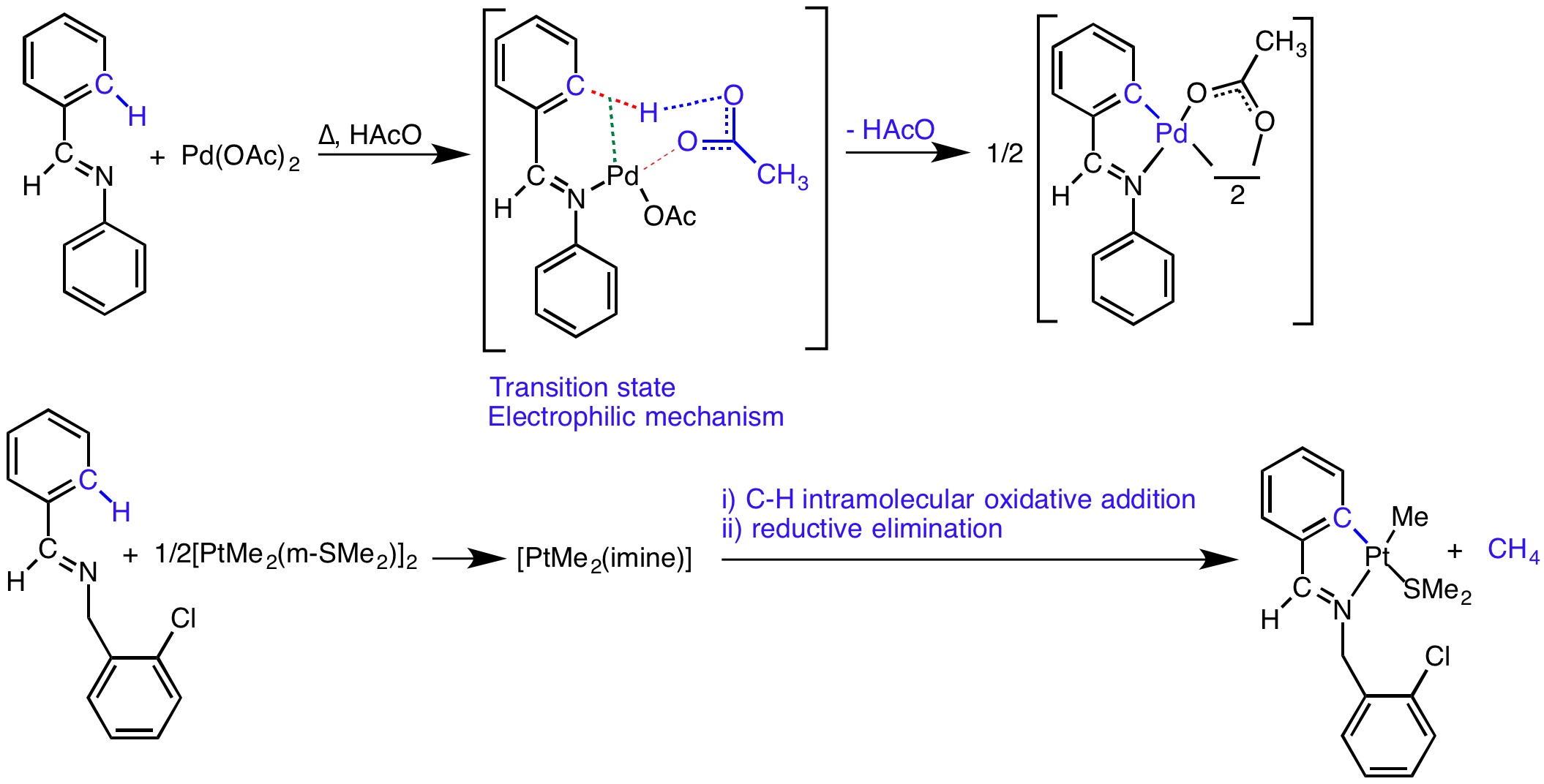
The intramolecular C-H activation reactions at Pd(II) and
Pt(II) complexes have been extensively studied. In the case of
Pd(II), the intramolecular C-H activation (cyclopalladation
reaction) takes place by an agostic interaction and with
the help of an internal base, usually an acetato ligand (Figure 3). This is called "the
electrophilic mechanism". Platinum(II), in function of its
coligands, can activate C-H bonds by the "electrophilic
mechanism" or by an oxidative addition mechanism. Figure 3 gives examples of
cyclo-palladation and -platination reactions, which take place
through the "electrophilic mechanism" or by the oxidative
addition mechanism.
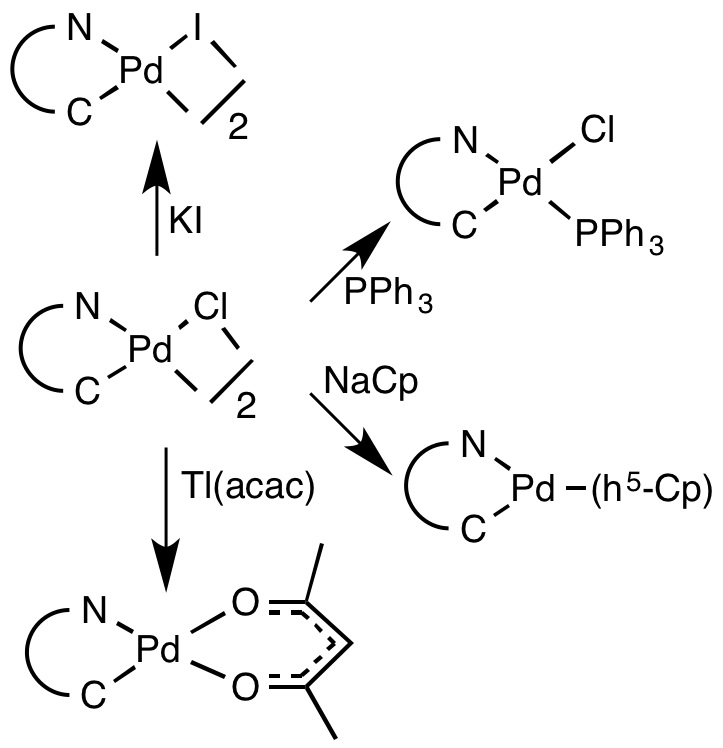
The reactivity of the cyclometallated compounds of the
platinum group metals has been extensively studied. These
compounds have a reach reactivity and can react with Lewis bases (Figure
4), nucleophiles and electrophiles and experience
oxidative addition, insertion and reductive elimination
reactions. The reactivity of the sigma metal-carbon bond or
that of the metallic centre of cyclometallated compounds of
the platinum group metals, especially those of Pd(II) and
Pt(II), has allowed the preparation of new organic or
organometallic compounds, such as those shown in Figure 5.
It should
be noted that: i) the cyclometallation reaction has been
used to introduce metal centres in organic polymers,
dendrimers and mesogens, ii) the catalytic functionalization of C-H
bonds in a
very important number of organic molecules with
an adequate directing group based on an intramolecular C-H
bond activation has been achieved using Fe(II), Ru(0), Ru(II),
Co(I), Co(III), Rh(I), Rh(III), Ir(I), Ir(III), Ni(II) and
Pd(II) compounds, among other transition metal compounds, as
catalysts,
and iii)
some cyclometallated compounds of the platinum group metals
are excellent catalysts for some organic reactions, such as
the Heck and Suzuki reactions and the Aza-Claisen reaction in
the case of those of Pd(II), among other organic reactions,
and have been applied in optical resolution, in supramolecular
chemistry, and in photophysics, in this latter case as sensors
for molecules or ions, as photochemical catalysts for redox
reactions, or as phosphors in OLEDs or in photovoltaic solar
cells.
Finally, it is also worth of mention that recently an
important number of articles of Pt(II), Pt(IV), Au(III),
Ru(II), Pd(II) and Ir(III) cyclometallated compounds deal with
their plausible applications in medicine and in biomedicine,
especially as anticancer agents or as luminescent probes for
the generation of bioimages.
Figura 1
Figura 2
Figura 3
Figura 4
Figura 5
The references listed below ordered by years
give detailed information on the precedent subjects (in red reviews and
minireviews and in green
books).